How AI Was Born in the Modern Era
How Artificial Intelligence Reached the Modern Era
Artificial intelligence feels sudden. One moment, software relied on rigid rules and simple automation; the next, machines could write essays, generate images, diagnose diseases, and assist in complex decision‑making. Headlines speak of disruption, job loss, and a future reshaped by algorithms. This apparent overnight transformation is misleading.
Modern AI is not a sudden invention. It is the outcome of nearly a century of theoretical ideas, repeated failures, algorithmic breakthroughs, and steady advances in computing. To understand how AI reached the modern era, we must trace its path carefully — separating myth from mechanism, hype from history.
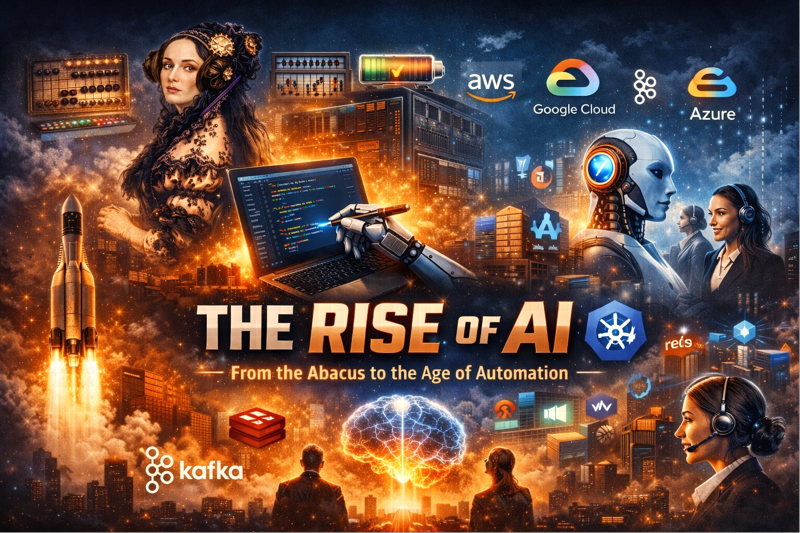
Before AI: Machines That Could Calculate, Not Think
The earliest computers were never designed to be intelligent. They were built to calculate faster than humans. In the 19th century, Charles Babbage’s Analytical Engine introduced the idea of a programmable machine. Ada Lovelace, writing about this design, made a crucial observation: such machines could manipulate symbols according to rules, but they did not originate ideas. This distinction — between mechanical execution and intelligence — would define debates about AI for generations.
By the mid‑20th century, electronic computers such as ENIAC and UNIVAC appeared. These machines followed explicit instructions, executed deterministically, and required programmers to specify every step. They were powerful, but intellectually inert.
The central question emerged: could a machine ever learn, rather than merely follow instructions?
The Birth of Artificial Intelligence as a Discipline
In 1956, at the Dartmouth Summer Research Project on Artificial Intelligence, the term “artificial intelligence” was formally introduced. Researchers including John McCarthy, Marvin Minsky, Allen Newell, and Herbert Simon believed that human intelligence could be described logically and implemented in machines.
Early AI systems followed a symbolic approach. Intelligence was treated as rule‑based reasoning. Programs such as ELIZA and SHRDLU demonstrated that machines could appear intelligent in constrained environments by manipulating symbols and applying handcrafted rules.
These systems impressed observers but failed to scale. Real‑world environments are uncertain, incomplete, and ambiguous. Rule‑based AI proved brittle, expensive to maintain, and incapable of adapting to new situations. Optimistic predictions repeatedly collapsed under practical constraints.
This gap between expectation and reality led to periods of reduced funding and enthusiasm — the so‑called AI winters.
The Critical Shift: From Rules to Learning
The defining transition in AI history was the move away from explicit rules toward systems that learn from data.
Neural networks, inspired loosely by biological neurons, had existed since the 1950s. Frank Rosenblatt’s Perceptron showed promise but suffered from severe limitations. Multi‑layer networks were theoretically powerful, but training them effectively remained difficult.
In the 1980s, renewed interest in neural networks emerged with the practical application of backpropagation, allowing multi‑layer models to learn internal representations. Still, progress was slow. Data was limited, computing power was expensive, and models were difficult to scale.
The ideas were ahead of the infrastructure.
When Compute, Data, and Algorithms Aligned
The modern era of AI began when three forces converged.
First, data exploded. The internet, search engines, social media, smartphones, sensors, and enterprise systems generated massive datasets describing human language, images, behavior, and interactions.
Second, compute became practical at scale. Graphics Processing Units (GPUs), originally designed for rendering images, proved exceptionally efficient at the parallel numerical operations required by neural networks. Cloud platforms made clusters of GPUs accessible without owning physical hardware.
Third, algorithms matured. Deep learning techniques demonstrated that stacking multiple layers of representation could capture complex patterns. In 2012, a deep neural network known as AlexNet dramatically outperformed traditional approaches in the ImageNet competition, signaling that deep learning could scale.
This was not a marginal improvement. It was a phase change.
Transformers and General‑Purpose Models
Another decisive breakthrough arrived in 2017 with the introduction of transformer architectures. By replacing sequential processing with attention mechanisms, transformers allowed models to capture long‑range relationships efficiently.
This architecture enabled the rise of large language models such as BERT, GPT, PaLM, and their successors. For the first time, a single model could perform many tasks — translation, summarization, reasoning, coding — without being explicitly programmed for each one.
AI systems shifted from narrow tools to general‑purpose assistants.
Infrastructure: The Force Multiplier, Not the Cause
Algorithmic breakthroughs alone do not change society. They must be deployed, maintained, and scaled.
Modern software infrastructure solved problems unrelated to intelligence itself: unreliable deployments, slow iteration, and systems that collapsed under load. Continuous integration and delivery pipelines automated testing and release. Containerization standardized environments. Orchestration systems managed distributed workloads. Cloud platforms eliminated the need to own and maintain physical servers.
These technologies did not create intelligence. They made intelligent systems usable.
Confusing infrastructure with invention obscures the real drivers of AI progress. Intelligence arises from data, compute, and algorithms. Infrastructure determines how widely that intelligence spreads.
From Elite Research to Widespread Access
For decades, advanced AI research was confined to a small number of institutions. Over time, access broadened. Open‑source libraries lowered technical barriers. Cloud services offered on‑demand training and deployment. Model APIs allowed developers to integrate powerful capabilities without building them from scratch.
Today, millions of people use AI daily — often without noticing it.
AI in the Modern World
AI now augments human work across disciplines. Developers write code with AI assistance. Designers generate and refine visual assets. Scientists analyze data at unprecedented scale. Businesses automate routine tasks and support decision‑making.
Despite public anxiety, most systems do not replace humans outright. They reshape workflows, amplify productivity, and shift skill requirements — a pattern consistent with earlier technological revolutions driven by electricity, computing, and the internet.
Not every system labeled “AI” truly deserves the name. Some are simple automation wrapped in marketing language. Others reflect genuine learning systems. Distinguishing between the two remains essential.
Conclusion: Why AI Feels Sudden — and Why It Isn’t
Artificial intelligence did not arrive overnight. It emerged gradually, crossing a threshold where decades of accumulated progress became visible.
From mechanical calculators to programmable computers, from symbolic rules to learning algorithms, from isolated labs to cloud‑scale systems, AI advanced through persistence rather than prophecy.
The modern era exists because conditions finally aligned.
And if history offers any lesson, it is this: what feels like an ending is usually the beginning of another chapter.