Almost Anyone Can Turn an Idea Into Software
Almost Anyone Can Turn an Idea Into Software
For a long time, building software meant learning a foreign language.
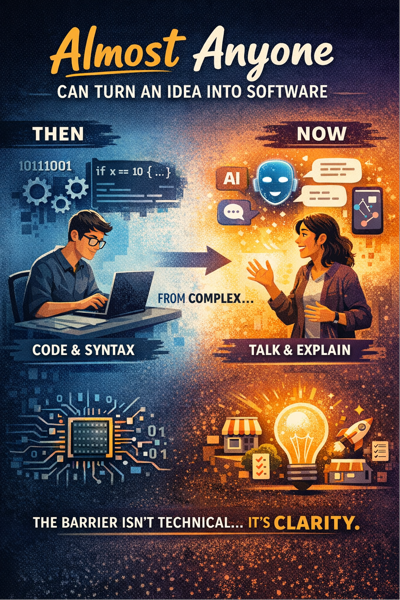
When people studied computer science or learned programming, they didn’t start by understanding how computers actually work at the lowest level. Very few developers truly understand binary or machine-level instructions. Instead, we learned programming languages that look like English and follow a strict set of rules.
That abstraction was intentional. It allowed humans to express intent without thinking about electrical signals or memory registers. Programming languages acted as translators between human thinking and machine execution.
Today, we’re seeing the next abstraction layer arrive.
Instead of learning syntax, people can describe what they want in natural language. You can type it, prompt it, or talk to an AI system, and it will translate your intent into code, designs, or working software.
This isn’t magic. It’s the same pattern repeating itself.
Computing has always moved toward reducing friction between human intention and machines. Machine code gave way to higher-level languages. Now those languages are being abstracted again, into conversation.
However, the phrase “now anyone can build software” needs to be handled carefully.
AI tools don’t remove the need for thinking. They still require iteration, troubleshooting, and some understanding of the problem domain. Writing good prompts is easier than learning programming, but it isn’t effortless. Absolute beginners still struggle, especially when things don’t work as expected.
The gap hasn’t vanished.
It has narrowed dramatically.
What has changed is who gets to try.
People no longer need years of technical training just to experiment with an idea. Students, founders, and non-technical professionals can now prototype, automate, and explore without waiting for a developer to translate their thoughts into code.
The bottleneck has moved.
Before, syntax and tooling blocked progress. Now, clarity of thought does. If you can explain what you want, recognize when something is wrong, and refine your instructions, you can build far more than was previously possible.
AI doesn’t replace understanding.
It amplifies it.
We’re not at a point where software builds itself. But we are at a point where building software is no longer exclusive.
And that shift—quiet, incremental, and easy to underestimate—is how real revolutions usually happen.